At four in the afternoon the bin held loose, separate pieces. By eight, the top layer has become one lump you have to break with a scoop. It is tempting to look for something you did wrong: the ice went in wet, the bin was too full, the freezer is failing. Usually nothing went wrong. What changed was the ice's temperature history over those few hours, and that history is what turns a pile of pieces into a single block.
The short answer: the clump is a weld, not a frozen puddle
Fused ice is not mainly meltwater that pooled and refroze. The pieces have bonded where they touch. Even below freezing, an ice surface carries a very thin, liquid-like layer. Where two pieces meet, water molecules move into the contact point and build a small neck of ice between them. Scientists call this process sintering.
Bonding happens slowly when the ice stays steadily cold and much faster when it sits close to 0 °C. Ordinary storage is rarely steady. Each time the temperature rises slightly, the surface layer gets wetter and the bridges can grow. Each time the temperature falls again, that new growth freezes in place. Repeat this through several small cycles and the bridges get thicker and more numerous. That is why clumping takes hours: it is too slow to happen in minutes, but the cycles can finish the job well before a day has passed.
The rest of this article follows that chain in order.
Ice is never completely dry, even below freezing
Solid ice does not wait until 0 °C to show liquid-like behavior at its surface. Physicists call this premelting: a thin, quasi-liquid film can exist on a solid's surface below its melting point, and the film gets thicker as the temperature rises toward melting.
Scientists have discussed this idea for a long time. A recent review of ice premelting traces it back to Michael Faraday. The same review notes that thickness measurements have differed by orders of magnitude depending on the technique, and that water does not fully wet ice. So be wary of any article that gives you a precise film thickness. The part that matters for an ice bin is well established:
- Even ice at freezer temperature is not perfectly dry; its surface still carries a thin, liquid-like layer.
- The closer the ice gets to 0 °C, the more pronounced that surface becomes.
That film is not a puddle, and you cannot feel it. It is enough, though, to let molecules rearrange where two pieces touch.
Where two pieces touch, an ice bridge grows

The best-known experimental description of this comes from D. Kuroiwa's 1961 paper, A Study of Ice Sintering, published in Tellus. The paper reports that ice particles bond at temperatures below 0 °C. When particles are brought together, they form necks, or ice bonds, that grow over time. Its photomicrographs show bonding at −5.0 °C at first contact, then at 33 minutes and 64 minutes, with the neck between the particles visibly larger at each stage.
Two details from that work explain what you see in a storage bin.
Bonding speeds up near the melting point. Kuroiwa writes that above about −2.0 °C, "quick ice-bonding takes place due to surface melting." Ice that sits just under freezing does not merely bond. It bonds quickly.
The exact molecular route is less important than the result. Researchers have attributed ice sintering to surface diffusion, and Kuroiwa's own measurements are consistent with volume diffusion, surface diffusion, or both. In practice, molecules move from the curved surfaces of each piece into the narrow gap where the pieces meet. This lowers the total surface area, and the contact becomes a solid joint.
What pressure does, and what it does not do
A common explanation is pressure melting: the weight of the ice above melts the contact points, and the water then refreezes into a bond. Kuroiwa's paper rejects this as the main explanation. It says pressure melting cannot account for adhesion between ice pieces when no pressure is applied, and in those experiments the ice still bonded.
Contact pressure still affects how much the pieces fuse:
- It enlarges each contact. A load presses touching surfaces into a flatter, wider contact, which gives a bridge more area to grow across.
- It packs pieces together. Weight from the ice above pushes pieces closer and creates more points of contact, so more bridges can form.
Following this mechanism, you would expect the bottom of a deep pile to fuse more completely than the top. Weight does not weld the ice. It creates more contact area, and sintering does the welding.
The same paper also reports that adhesion depends strongly on the surrounding vapor pressure. Citing earlier work by Hosler, it notes that ice did not adhere below certain temperatures when the air was drier than ice saturation. Humidity does play a part. In a closed bin full of ice, however, the air is already close to saturation, so the variable that changes from hour to hour is temperature.
The real clock: temperature cycling

If sintering were the whole story, steadily cold ice would bond gradually and predictably. Real storage keeps moving the ice into and out of the fast-bonding range.
Penn State Extension's explanation of freezing describes this pattern in food storage, and the same mechanism applies to ice. During the defrost period of a frost-free freezer, the contents thaw slightly and then refreeze, and ice crystals grow during the refreeze. Opening the door lets warm air in and starts the same freeze–thaw cycle again.
Apply that to a bin of ice:
- Warm excursion. A defrost cycle, an open door, or warm air reaching the bin raises the ice surface toward 0 °C. The liquid-like layer thickens, contact points become more mobile, and bridges grow quickly in the range where Kuroiwa observed fast bonding.
- Return to cold. The temperature drops again. The extra surface water freezes, and whatever growth happened at the contacts becomes solid ice.
- Repeat. Each later excursion starts from wider, stronger bridges than the one before. Bonds do not simply appear. They build up in stages.
This explains the few-hour timeline. A single brief excursion is usually not enough to lock a bin solid. Over an evening of door openings, or across one or more defrost periods, the bridges keep accumulating until loose pieces become a block.
It also explains why the timing varies. Two batches of ice from the same machine, stored in the same bin, can clump at very different rates if one sat undisturbed while the other went through several warm-ups. This is why fast clumping alone does not prove that the ice went in wet, that the bin was overfilled, or that a component has failed. Look at how many temperature swings the ice went through first.
Ice kept in an unrefrigerated bin near 0 °C is a more extreme example. It does not move into the fast-bonding range now and then. It stays there, which makes bonding faster still.
Why nugget ice fuses first

Nugget ice, also called pebble or Sonic-style ice, usually forms a solid mass sooner than standard cubes. The reason is its structure. As we explain in our guide to nugget ice vs. crushed ice, nugget ice is made of compacted flakes, and its porous structure holds onto flavor.
Apply the sintering mechanism to that structure:
| What drives bonding | Solid cube | Nugget ice |
|---|---|---|
| Surface where premelting happens | Mostly the smooth outer faces | The outer surface plus flake edges and pores |
| Contact points with neighbors | Relatively few, at edges and faces | Many small, irregular contacts on every piece |
| Water held inside the piece | Little | Some held in pores between compacted flakes |
These differences follow from how each type of ice is built. They are not measured values. More exposed surface means more premelt layer. More contact points mean more places for bridges to start. Water held in the pores is already available to freeze into bonds when the temperature drops again. Nugget ice goes through the same temperature cycles as cubes, but each cycle has more places to form bonds.
What this means if you are choosing a nugget ice machine
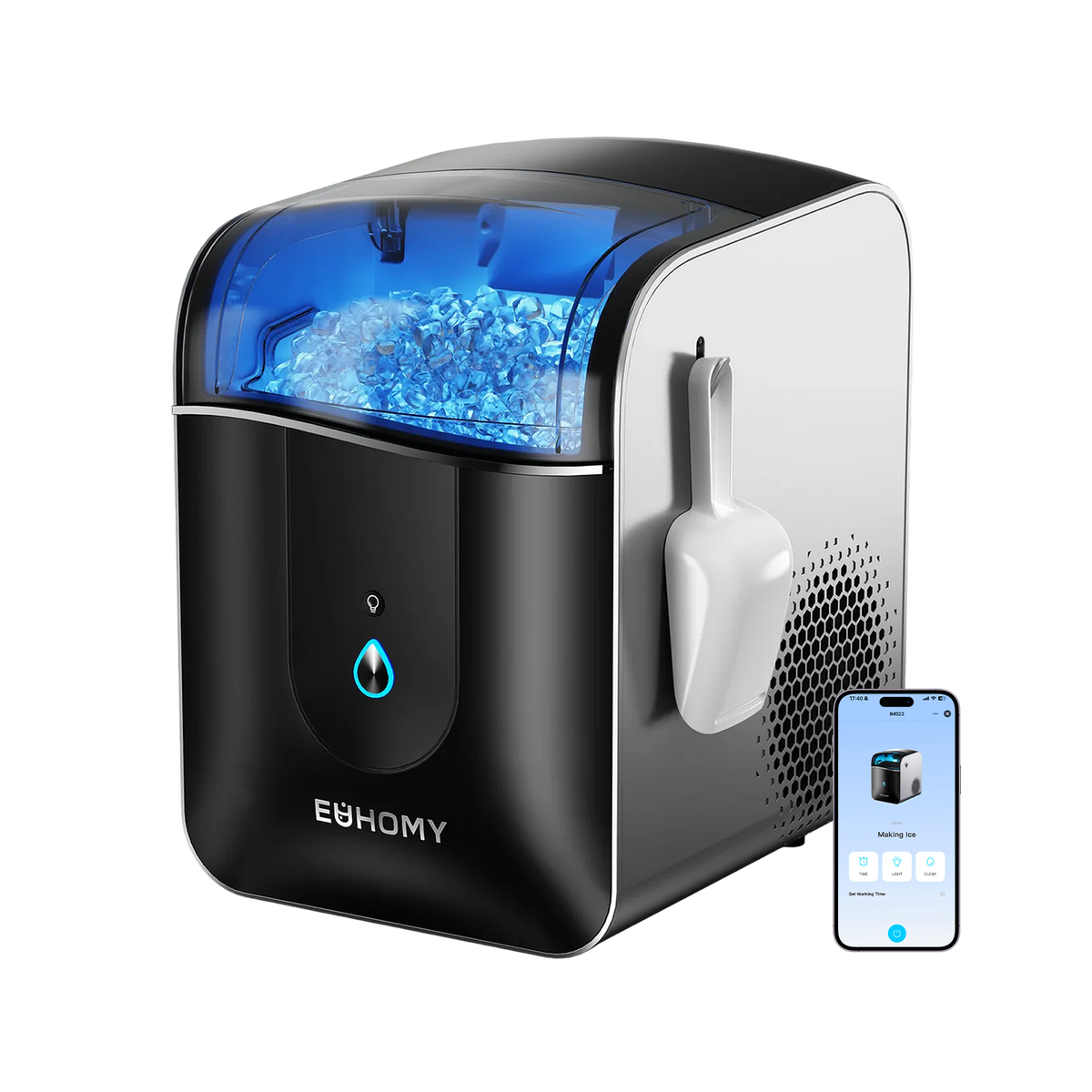
Because nugget ice is especially sensitive to temperature history, the storage bin is part of the picture alongside how quickly a machine makes ice. Our Euhomy Lyra S1 Nugget Commercial Ice Maker produces 66 lb of nugget ice in 24 hours and uses a double-layer ice box design with an 18-pound storage capacity. Its insulation system keeps 80% of the pebble ice unmelted for a full day, even when the bin is full.
That retention figure measures melting. It does not measure whether the pieces stay loose. Ice in any bin still has a premelt layer and still forms bridges where pieces touch. When comparing machines, look beyond daily output. Check how much ice the bin holds and how well the machine says it keeps that ice from melting. Then compare both against how long ice usually sits in your bin before you use it.
What this explains, and what it does not
The mechanism gives you a way to judge what you are seeing:
- A block that forms after a few hours is normal ice physics. Contact, premelting, and repeated warm-and-cold swings are enough to cause it. On its own, it is not a sign of a fault.
- Timing depends on temperature history. Clumping is faster when ice stays near 0 °C or goes through frequent warm-ups. It is slower when ice stays steadily cold and undisturbed.
- Weight matters, but not because it melts the ice. Deeper piles fuse more because they have more and larger contact points.
- Nugget ice fuses sooner for structural reasons. Its compacted, porous flakes give the same process more surface and contact area.
The mechanism does not provide a single fixed number of hours, degrees, or cycles after which ice will lock together. Those depend on the bin, the room, and how often the ice is disturbed. If you want to reduce clumping, our routine for stopping ice from clumping together in your storage bin explains what to change. Now that you know the bonds form gradually through repeated temperature swings, you can see what each step in that routine is designed to interrupt.