If you have ever stood at the sink twisting a sphere mold while a tapered bullet tray gave up its ice with one push, you have already seen the answer. In a rigid mold, a tapered bullet cavity releases more easily than a sphere cavity. The bullet's widest end is the opening, so the ice has a clear way out. A ball's widest circle sits inside the cavity, so the ice is trapped until the mold splits at that circle (the equator) or the wall is soft enough to peel away.
The easiest way to see why is to treat release as two separate jobs:
- Adhesion to beat: the bond between ice and the mold wall.
- Interference to clear: any part of the mold that physically blocks the ice's path out.
The cavity's shape decides both jobs, and it matters more than how much surface the ice touches.
Why surface area alone gets this backward
Here is the counterintuitive part. At equal volume, a sphere has less surface area than any other shape. If release were only about contact area, the ball would come out easiest, since it has the least wall to stick to.
It doesn't, because contact area is only half the problem. A sphere in a one-piece rigid cavity has total interference: wherever you push, the widest part of the ice is still stuck behind a narrower ring of mold. A bullet has more surface for its volume, but its walls lean outward toward the opening, so once the bond breaks nothing stands in the way. Geometry beats square inches.
Draft angle: the molding principle behind easy release

Manufacturers of molded parts deal with the same problem. In injection molding, walls that run parallel to the direction the part is pulled out are angled slightly to ease release. That angle is called draft. Without enough draft, the part can deform or get damaged on the way out, and deeper cavities need more draft than shallow ones.
Ice follows the same rule. A cavity whose walls widen toward the opening has positive draft, so the piece pulls free. A cavity that narrows toward the opening has negative draft, which means an undercut, and the piece can't come straight out at all.
Depth matters here as well. Bullet cavities are tall and close to straight-sided, the deep kind of cavity that most needs its taper. A bullet tube with almost no taper behaves like a stiff drinking straw full of ice: all friction and no clearance. The taper is what makes a deep bullet cavity work.
Sphere molds: the widest point is on the inside
A sphere is close to the worst case for draft. From the opening down to the equator, the wall curves outward, so the cavity has negative draft at exactly the point where the ice is widest, and the equator is where a rigid mold would have to grip hardest. Past the equator it curves back in. That leaves three ways a sphere mold can work:
One-piece rigid cavity. There's no exit path. The ice can't get past the narrower opening without breaking or melting down, which is why rigid sphere molds are almost never made as one solid piece.
Two-piece rigid mold split at the equator. Splitting the mold at the widest circle removes the interference, since each half is now a shallow bowl with its opening at its widest point. The tradeoff is that you now have a frozen seam where water seeped into the joint and froze, plus two hemispheres that each cling to the ice across their whole curved surface. You have to break the seam and both bonds before the ball comes free.
Thin silicone wall. Soft silicone gets around the undercut by bending out of the way. It also changes how you break the bond. Pulling a rigid half straight off makes the ice let go of the whole contact patch at once. Peeling silicone puts the force on a moving line where the wall is lifting away, so only a narrow strip lets go at any moment. That takes far less force than shearing the whole surface at once.
How hard ice grips a surface isn't a fixed number. Ice adhesion research shows it depends on temperature, surface roughness, and how the load is applied. That's why warming the mold or switching from pulling to peeling changes how much effort the release takes.
Tapered bullet cavities: clearance from the first millimeter
A bullet cavity is basically one long draft angle. The closed end is narrow, the open end is wide, and there's no band partway down where the wall curves back in.
So once the adhesive bond breaks and the ice moves even slightly toward the opening, a gap opens between the ice and every wall. The rest of the push is nearly frictionless, because the ice is moving into a space that keeps getting wider. The only real job is breaking the initial bond.
Keep one caution in mind with machine-made bullet ice. It typically has a hollow center, so the wall is thin and can crack if you squeeze it hard. Push it gently. Don't crush it.
Why partially frozen ice is harder to release
Many stuck molds aren't a shape problem at all. They're a freezing problem.
Water expands by a little over 9% as it freezes. In a clamped two-piece mold, that expansion presses ice hard against every wall and forces it into the seam.
Now consider a ball that hasn't frozen through. From the outside it looks solid, but it's really a thin frozen shell around liquid water. When you twist or pull, the shell doesn't slide out as one rigid piece. It flexes into the wall, grips harder, and cracks along the seam. You end up with a broken ball and a wet mold.
The practical rule: freeze through the thickest part before you demold. Check that the piece is hard and evenly opaque all the way through, with no soft spots or clear liquid pocket in the middle. A sphere is thickest at its center, so it takes noticeably longer than a slim bullet of the same weight.
Sphere cavity vs. tapered bullet cavity at a glance
| Sphere cavity | Tapered bullet cavity | |
|---|---|---|
| Exit path | None in a one-piece rigid mold; opens only if the mold splits at the equator or peels | Built in: the widest end is the opening |
| What resists release | Undercut above the equator, frozen seam, adhesion across two hemispheres | Mostly the initial adhesive bond along the walls |
| What frees it | Warming the mold, working the seam, peeling a soft wall | Brief warming and a gentle push from the narrow end |
| Typical failure mode | Cracking along the seam or chipping when halves are forced apart | Sticking in a deep cavity with too little taper; cracking a thin-walled piece by squeezing |
Release techniques, in order

Start with the gentlest step and only move on if the ice is still stuck.
- Let it rest briefly on the counter. A thin mold warms faster than a dense block of ice, so a short rest loosens the bond at the wall before the ice itself starts to melt.
- Run warm water over the outside of the mold. Use warm water, not hot, and keep it on the outside. This works especially well for sphere molds. Testers at Serious Eats found that when the halves of a sphere mold stuck, a brief rinse under warm water freed them.
- Work the seam, then peel. On a two-piece mold, loosen the frozen joint all the way around before separating the halves. On silicone, peel the wall back from one edge instead of pulling the halves apart.
- Push from the narrow end. For tapered cavities, press the closed tip toward the opening with your thumb or the mold's own base, so the ice moves into the widening gap.
What not to do:
- Don't pry with metal. Knives and spoons scratch the mold, and a rougher surface grips harder the next time.
- Don't torque a rigid two-piece mold. Twisting loads the seam unevenly and tends to crack the ball along it.
- Don't pour hot water on thin plastic. It can warp the cavity, and a warped cavity loses the fit and draft it needs to release cleanly.
If demolding is the part you'd rather skip
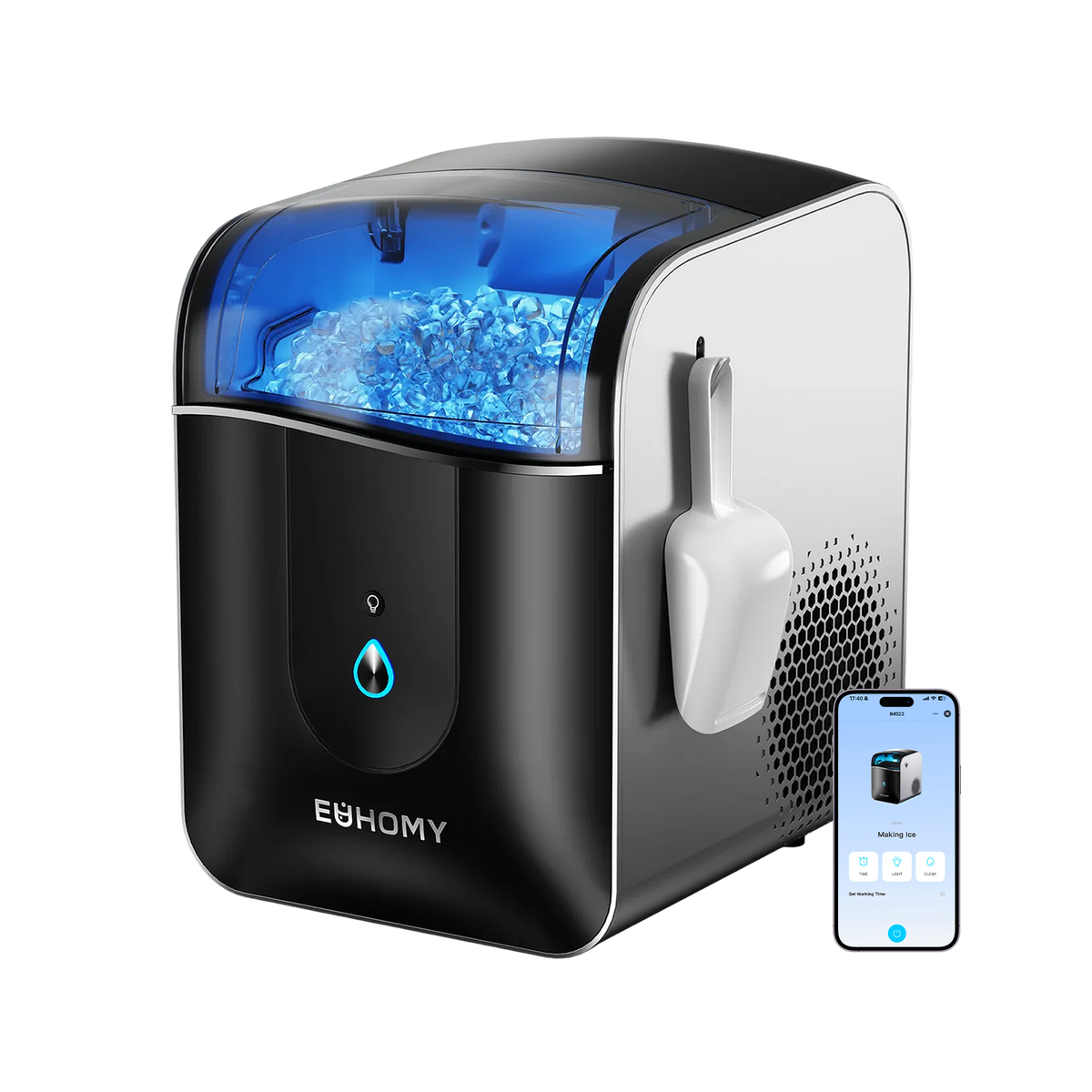
For some people, the real frustration isn't the shape. It's the whole cycle of filling, freezing, warming, and coaxing ice out of molds. If bullet ice works for your drinks, you can skip that cycle entirely. Just keep in mind that a machine like this makes bullet ice, not spheres, so it won't help if you want a ball in the glass.
The Euhomy Dart H1 Silver Bullet Ice Maker makes 9 bullet-shaped ice cubes in 6 minutes. It has a 1.2L water tank, makes up to 26.3lbs of ice per day, and holds up to 1.3lbs of ice at a time. The bullet-shaped cubes are smooth and won't stick together easily, which makes them a good fit for cold drinks or iced coffee.
The geometry test for any mold
Before you fight a stuck piece, find the widest part of the ice and ask whether the mold can open at that point or peel away from it. If the widest point is at the opening, as in a tapered bullet cavity, the ice will release with a little warmth and a push. If the widest point is trapped inside, as in a sphere, the mold has to split at that circle or bend out of the way, and the ice has to be frozen solid before either one will work.